Why a "Badly Behaved" Dog Is Usually Just a Bored One. And the 15-Minute Habit More Owners Are Trying at Home.
A note we wanted to pass along to the community. Here is the real reason most dogs ignore, chew, and bark, and the gentle, force-free approach a growing number of owners are using to turn it around.

It is the look that gets you. You come home to the chewed shoe, the cushion stuffing across the floor, or the third "accident" of the week, and your dog meets your eyes with that mix of guilt and hope. And somewhere in the back of your mind, a quieter question lands: am I doing something wrong?
If you have asked yourself that, you are not alone, and you are almost certainly not the problem.
Most owners who struggle with a dog that won't listen, pulls on the leash, barks at everything, or falls apart when left alone have already tried. The obedience class. The YouTube videos. The treats. The "just be the alpha" advice from someone at the park. And when none of it sticks, it is easy to decide that either the dog is stubborn or you are failing it.
Here is the part that changes the whole picture: most everyday dog problems are not obedience problems at all. They are boredom problems. And once you see that, the fix stops looking like a battle of wills and starts looking like something far gentler.
The short version
A smart dog with nothing to do will invent its own job, and it is usually one you won't like: chewing, barking, digging, pacing, escaping. The behavior is not defiance. It is an under-stimulated brain looking for work.
Give that brain something better to do, and a surprising number of "bad" habits quietly fade. That is the shift a growing group of owners is now making at home.
Why "more exercise" often isn't the answer
When a dog is bouncing off the walls, the standard advice is to walk it more. And physical exercise matters. But many owners discover the hard truth that you cannot out-walk a bored brain. You take the dog for a long walk, it sleeps for an hour, and then it is up again, restless, looking for trouble.
That is because physical exercise tires the body, but it does very little for the mind. And for most dogs, the mind is the part that needs a job. Dogs were bred to work: to herd, to retrieve, to track, to solve. A modern dog in a comfortable home often has all of that intelligence and almost nothing to point it at.
So the dog that destroys the house when left alone is not being spiteful. The dog that ignores you on the walk is not being dominant. In most cases, they are simply under-stimulated, and the behavior is the symptom. That reframe matters, because it points to a completely different kind of solution, one that does not involve dominance, scolding, or anything that feels bad to do to an animal you love.
The approach more trainers quietly rely on: mental stimulation
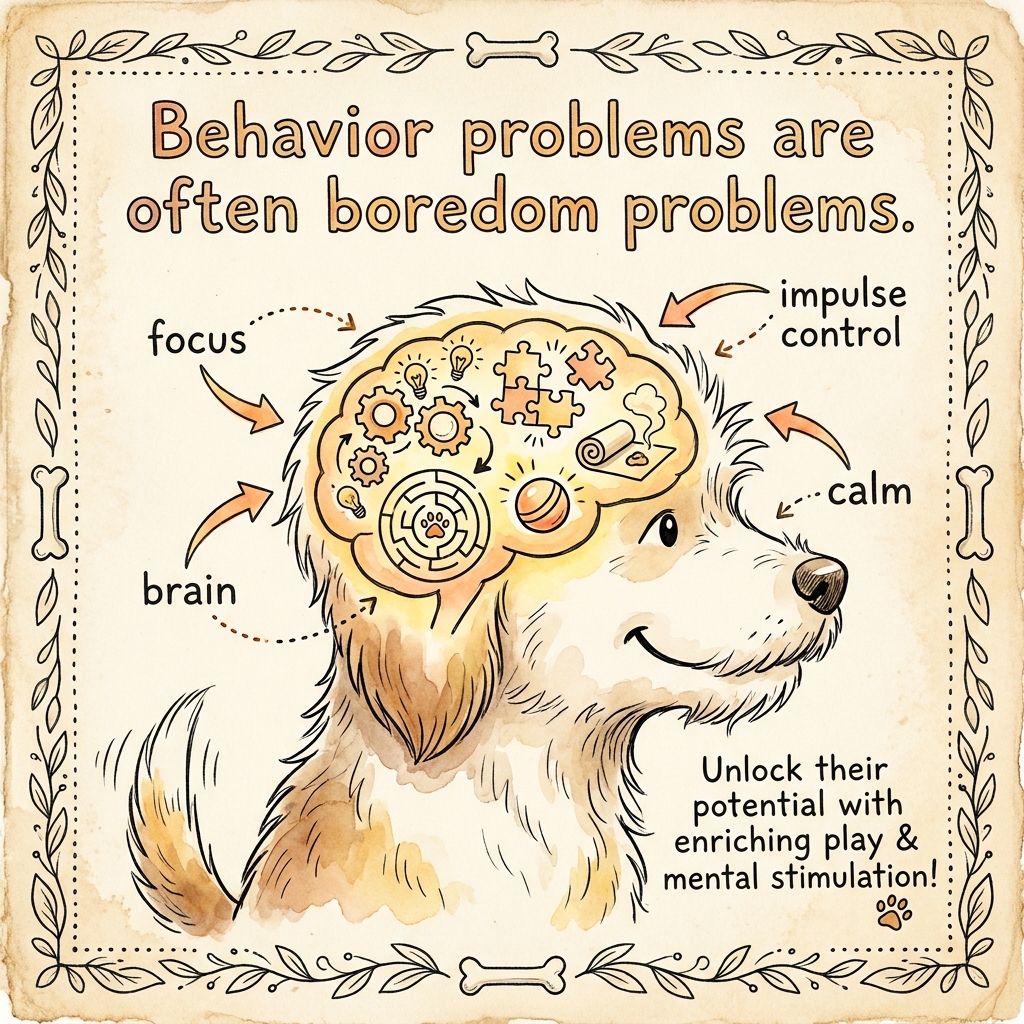
Once you understand that behavior problems are usually boredom problems, a different category of training starts to make sense. Instead of drilling commands or correcting bad habits after the fact, the idea is to engage the dog's mind with short, structured games that build focus, problem-solving, and impulse control.
This is not a gimmick, and it is not new. Force-free, positive-reinforcement trainers have used mental-stimulation work for years, because it does two things at once: it tires the dog out in the way that actually calms it, and it strengthens the very skills (attention, self-control, looking to you for direction) that make a dog easier to live with. A dog that has learned to think and focus through games tends to carry that focus into the rest of its life.
It is the same logic behind enrichment in any thoughtful setting: give a clever mind a worthwhile job, and a lot of the "problem" behavior simply has nowhere to go. For owners used to thinking of training as obedience drills or being the alpha, this is a meaningful shift, from fighting the dog's nature to working with it.
Brain Training for Dogs: the simple, at-home version of this approach
Of the programs built around this idea, the one a lot of owners have been talking about is Brain Training for Dogs, a course created by Adrienne Farricelli, a CCPDT-KA certified professional dog trainer whose work has appeared in USA Today and the APDT Chronicle of the Dog.
The premise is straightforward. Rather than a thick obedience manual, it is a set of 21 progressive games designed to build a dog's focus, intelligence, and self-control step by step. The games are short, force-free, and meant to be played at home in around 15 minutes a day. No special equipment, no harsh corrections, no dominance theory, just a structured way to give your dog's brain the job it has been missing.
Force-free
Positive games, not dominance, scolding, or shock. Kind to do, and kinder to live with.
About 15 minutes
Short sessions that fit a real schedule. Consistency matters more than length.
Any age, any dog
The games scale by difficulty, so puppies and older dogs can both start where they are.
How owners use it
Start with a simple game
Begin at the easiest level to build your dog's confidence and focus.
Play for a few minutes a day
Short, upbeat sessions. The goal is engagement, not exhaustion.
Progress through the levels
As your dog gets it, the games get more challenging, and the focus carries into daily life.
Tires the body, or tires the dog?
This is the reframe at the heart of it, and it is worth seeing side by side.
None of this means walks don't matter. It means the missing ingredient for most "problem" dogs is mental, not physical. And mental work is something you can do on a rainy day, in a small apartment, with an older dog, in a few minutes, which is exactly why so many owners find it easier to keep up than another hour-long walk.
"But will it actually work for my dog?" The honest questions owners ask
Healthy skepticism is the right instinct for any product, so it is worth walking through the real questions out loud.
A note on reviews
We don't publish customer reviews we can't independently verify. Instead, here's what this approach is designed to do, and what it can't do, so you can decide for yourself.
What it is designed to do: build focus, impulse control, and engagement through short, force-free games, so a bored, under-stimulated dog has a better outlet and is easier to live with. What it can't do: guarantee a specific result for every dog, or replace a qualified trainer or veterinary behaviorist for serious issues like real aggression or severe anxiety. It is a training approach, not a cure-all.
The "old dog, new tricks" line is mostly a myth. Older dogs learn well, and they often benefit the most from mental stimulation, because boredom and under-stimulation are common as dogs slow down physically. The games start easy and build up, so an older dog can begin gently at its own pace.
The underlying idea, that mental stimulation and impulse-control work improve behavior, is well established in force-free training. The program is simply a structured, beginner-friendly way to do it, created by a certified professional trainer. It is a method, not magic, and it works best as a consistent habit.
That is part of the appeal. The sessions are short, around 15 minutes, and many owners find that a few focused minutes of brain work does more for their dog's behavior than a much longer walk. Consistency matters more than duration.
Force-free, positive-reinforcement methods are what most modern certified trainers and behavior organizations recommend, precisely because they build trust and lasting focus rather than fear. You are not being permissive; you are giving the dog a clear, rewarding job to do.
That is what the guarantee is for. Brain Training for Dogs is sold through ClickBank, which backs purchases with a 60-day money-back guarantee, so you can try the approach and decide for yourself with your purchase protected. Details are below.
Backed by a 60-Day Money-Back Guarantee
Brain Training for Dogs is sold through ClickBank, which provides a 60-day money-back guarantee on your purchase. If it is not the right fit within 60 days, you can request a refund through ClickBank's standard process. That makes trying the approach a low-risk decision. Current guarantee terms are shown on the product's ClickBank checkout page.
The kinder shift more owners are making
None of this is about blaming yourself, and none of it is about dominating your dog. It is about a simple change in how you see the behavior: not as a battle to win, but as a brain that needs a job.
That is really why more owners are folding short brain games into their routine. Not because it promises a perfect dog overnight, but because the trade is reasonable and kind: a few engaged minutes a day, in exchange for a calmer, more focused companion and a lot less frustration for both of you.
Picture the version of your dog that gets to use its mind every day. Less restless. More tuned in to you. Easier on the walk, calmer at home, and far less interested in the shoes. That dog is not a fantasy, and it usually is not a matter of being stricter. It is a matter of giving a bored, clever brain something better to do.
If your dog's behavior has had you wondering whether you are the problem, it is worth a few minutes to see how this approach works for yourself.
Your dog isn't bad. He's bored.
Give that clever brain a job, and a lot of the trouble takes care of itself. See the gentle, force-free approach more owners are switching to.